
Skin Undertone Test: Warm, Cool, Neutral, or Olive?
Your skin undertone is one of the first clues in personal color analysis. It helps explain why one white shirt makes your face look clear while another makes you look tired, or why one lipstick looks natural while another turns orange or gray.
But a good skin undertone test is not just the old "look at your veins" trick. Veins, jewelry, tanning, and foundation can help, but each clue can be misleading on its own. The most useful test compares how colors behave near your face.
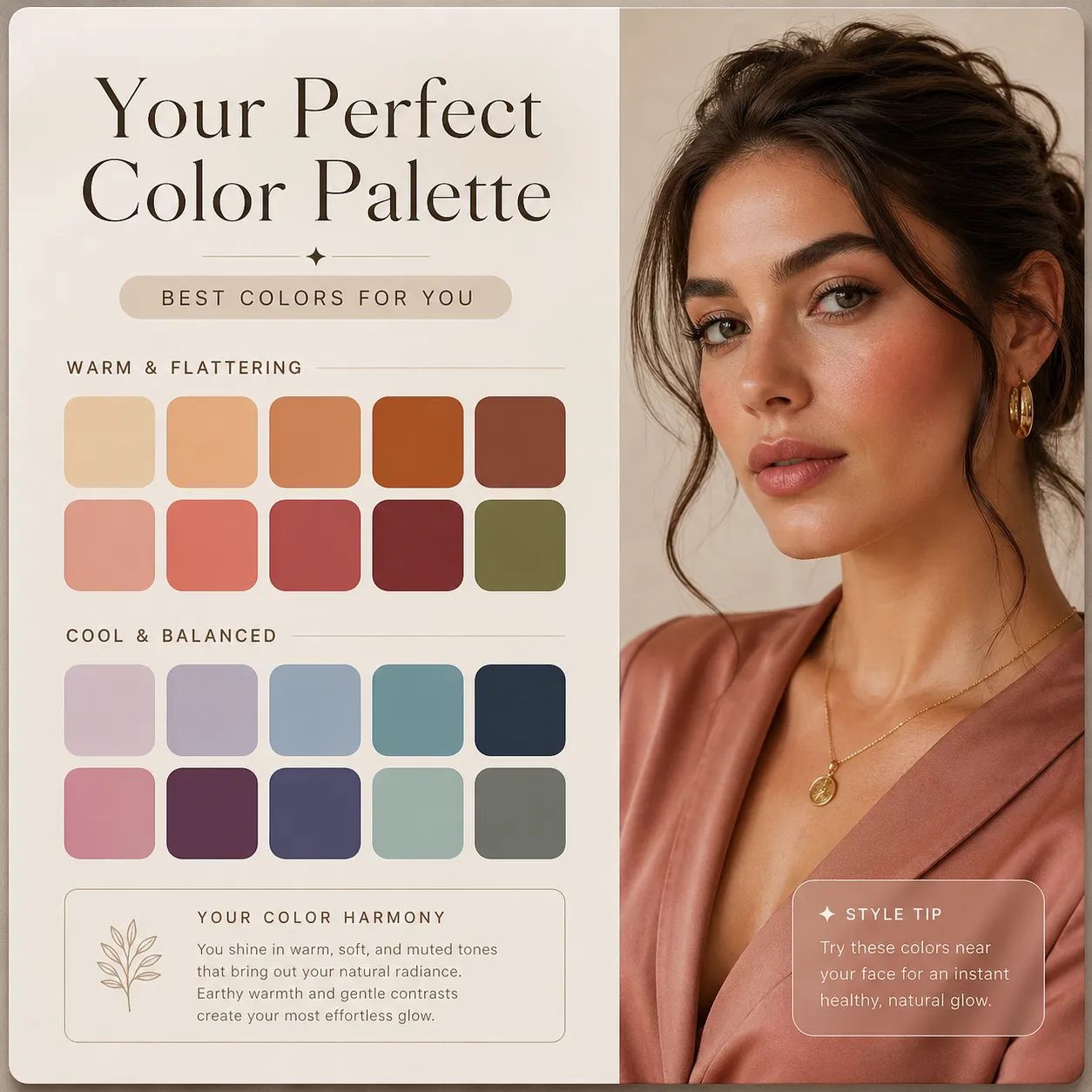
Undertone is one clue, not the whole answer. A reliable color result should also consider contrast, depth, hair color, and photo quality.
What is a skin undertone?
Skin tone is how light or deep your skin appears on the surface. Undertone is the color bias underneath the surface.
Most people fall into one of these groups:
- Warm undertone: golden, peachy, yellow, or warm beige direction.
- Cool undertone: pink, rosy, blue, or cool beige direction.
- Neutral undertone: balanced warm and cool signals.
- Olive undertone: green, muted, or gray-green balance that can read warm in some light and cool in other light.
Undertone is not the same as ethnicity or skin depth. Two people with the same skin depth can need very different clothing colors, lipstick shades, and hair colors.
What this test can and cannot tell you
A skin undertone test can help you choose better whites, neutrals, lipstick families, blush tones, and hair color direction. It cannot identify every best color by itself.
You still need to look at:
- contrast between skin, hair, brows, lips, and eyes
- whether your coloring is bright or muted
- natural hair depth
- dyed hair that may be changing the frame around your face
- photo quality and lighting
If your undertone result is close between two categories, treat it as a direction to test, not a final label.
Why the vein test is not enough
The common vein test says green veins mean warm undertone and blue veins mean cool undertone. It can be a clue, but it is not reliable enough by itself.
Veins are affected by skin depth, lighting, camera exposure, and how close they sit to the surface. Olive undertones can also make the vein test confusing because the skin has a muted green balance.
Use the vein test as one clue, then confirm with color comparison.
The two-minute window-light test
Stand near a window in natural light. Avoid strong filters, colored walls, or heavy makeup. Compare color pairs near your face and watch what happens to your skin, lips, eyes, and shadows.
| Compare | Warmer option | Cooler option | What to watch |
|---|---|---|---|
| White | Cream | Pure white | Which makes skin smoother? |
| Neutral | Camel | Cool gray | Which looks cleaner near your face? |
| Pink | Peach | Icy pink | Which supports your lips and cheeks? |
| Red | Tomato red | Blue-red | Which makes eyes clearer? |
| Green | Olive | Emerald | Which looks harmonious, not harsh? |
| Metal | Gold | Silver | Which looks natural against skin? |
The better color usually makes your face look clearer, not just the outfit more interesting.
Take a quick photo of each comparison. Do not rely only on the mirror, because your eyes may adjust to the room light. If the camera makes your skin too yellow, too gray, or too bright, retake the photos before deciding.
Warm undertone signs
Warm undertones often look good in:
- cream instead of stark white
- camel, tan, warm beige
- olive, moss, warm khaki
- coral, peach, tomato red
- chocolate brown, espresso, bronze
- gold jewelry
Warm undertones can look dull in icy gray, blue-pink, or chalky pastels, especially near the face.
Cool undertone signs
Cool undertones often look good in:
- soft white or crisp white
- cool gray, navy, charcoal
- rose, berry, plum
- blue-red, raspberry, fuchsia
- emerald, pine, cool teal
- silver jewelry
Cool undertones can look yellowed or tired in orange-heavy beige, camel, and warm mustard.
Neutral undertone signs
Neutral undertones can usually borrow from both warm and cool palettes, but depth still matters.
Good starting colors include:
- ivory
- taupe
- rose beige
- muted teal
- soft navy
- cocoa
- balanced red
If you are neutral, your best result usually depends more on contrast, brightness, and softness than on temperature alone.
Olive undertone signs
Olive undertone is often missed because it does not fit cleanly into warm or cool.
Olive skin may look slightly green, muted, gray-gold, or beige-green. It may react badly to both very orange colors and very icy colors.
Good starting colors include:
- warm gray
- olive
- moss
- deep teal
- espresso
- muted rose
- bronze
- cream
If every foundation looks too pink, too orange, or too flat, olive undertone may be part of the answer.
Olive can be warm-leaning, cool-leaning, or neutral-leaning. That is why some olive skin looks great in cream and bronze, while other olive skin looks better in muted rose, deep teal, or cool espresso.
How undertone affects makeup
Undertone matters most when makeup sits directly on your skin.
Warm undertones often prefer peach blush, coral lipstick, bronze eyeshadow, and warm brown liner. Cool undertones often prefer rose blush, berry lipstick, taupe eyeshadow, and charcoal or cool brown liner.
Neutral undertones can choose based on outfit and contrast. Olive undertones often need muted warmth, not bright orange.
For a deeper makeup guide, read What Lipstick Color Suits Me.
How undertone affects hair color
Hair color changes the contrast around your face. A warm undertone may look harmonious with caramel, chestnut, copper-brown, or golden brunette. A cool undertone may look clearer with ash brown, cool espresso, beige blonde, or soft black.
The best hair color also depends on eye color, natural hair depth, and contrast. Read What Hair Color Suits Me if hair color is your main question.
Common undertone mistakes
- Using only vein color.
- Testing under yellow indoor light.
- Wearing strong makeup during the test.
- Comparing colors on your wrist instead of near your face.
- Confusing tanning with undertone.
- Assuming all deep skin is warm or all fair skin is cool.
- Ignoring olive undertone.
When to retake the test
Retake your undertone test if:
- your photo was taken at night or under warm indoor bulbs
- the face is backlit or shadowed
- your skin is covered by heavy foundation
- a colored wall or shirt is reflecting onto your face
- your phone filter changes skin texture or lip color
- the result says low confidence or feels split between warm and cool
A retake is not a failure. It usually means the first input did not show enough reliable color information.
Next step
Once you know your likely undertone, combine it with contrast and seasonal color direction. That is where your full palette becomes useful for clothing, makeup, hair color, and outfit planning.
Use the What Color Suits Me Quiz for a structured test, or read What Color Suits Me? for the full guide.