
What Hair Color Suits Me? Find Your Best Shade
If you are asking "what hair color suits me?", you are probably trying to avoid an expensive mistake. Hair color sits directly next to your face, so the wrong shade can make your skin look tired, red, gray, or harsh. The right shade can make your features look clearer before you change anything else.
Hair color is not only about warm vs cool. The best shade depends on undertone, contrast, natural hair depth, eye color, and how much maintenance you want.
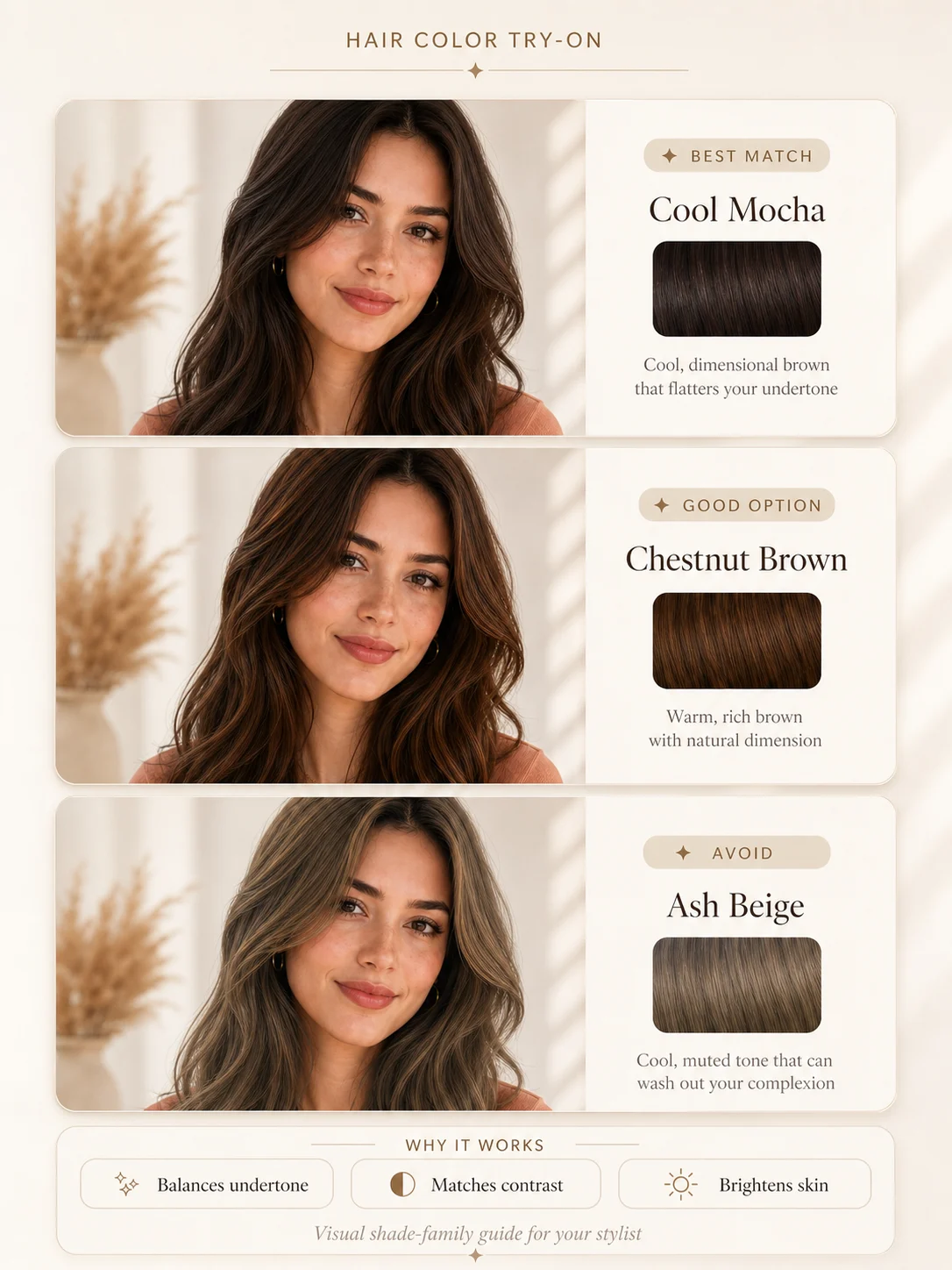
Hair color analysis is most useful when it becomes a salon decision tool: tone direction, depth, contrast, maintenance, and colors to avoid.
Use the result as salon direction
Do not bring a stylist only one celebrity photo. Bring direction language:
- warmer or cooler
- softer or clearer
- lighter or deeper
- dimensional or solid
- lower maintenance or higher impact
A good color report should help you say "soft neutral brunette with subtle beige dimension" instead of only "brown hair." That gives your stylist room to adapt the shade to your starting color and hair condition.
Start with undertone, then refine it
| Undertone | Hair colors to test | Be careful with |
|---|---|---|
| Warm | caramel, golden brown, chestnut, copper-brown, honey blonde | icy ash, blue-black |
| Cool | ash brown, cool espresso, beige blonde, soft black, cool brunette | orange copper, yellow blonde |
| Neutral | soft brunette, neutral brown, beige blonde, cocoa, balanced auburn | extreme warmth or extreme ash |
| Olive | espresso, mushroom brown, muted bronze, deep neutral brown | bright orange, flat black, chalky blonde |
If you are unsure about undertone, start with the Skin Undertone Test.
Undertone is a guardrail, not the whole formula. A warm undertone may still need a muted brunette instead of bright copper. A cool undertone may need beige-cool softness instead of flat ash.
Check your natural contrast
Contrast is the difference between your skin, eyes, brows, lips, and hair.
High contrast features can often handle deeper hair colors, such as espresso, dark brunette, or dimensional black-brown. Low contrast features often look better with softer shades that do not overpower the face.
If your natural coloring is soft, a dramatic black or platinum blonde can become the first thing people see. If your natural coloring is high contrast, a very muted color can make your features feel flat.
The safest change is usually one or two levels from your natural depth. Big jumps can work, but they require stronger makeup, more salon maintenance, and a clearer plan.
Use your season as a guardrail
Seasonal color analysis can narrow the range:
- Spring palettes often suit warm, clear, light-to-medium hair colors.
- Summer palettes often suit cool, soft, muted hair colors.
- Autumn palettes often suit warm, earthy, rich hair colors.
- Winter palettes often suit cool, clear, high-contrast hair colors.
For a full overview, read Seasonal Color Analysis Quiz.
Choose hair color by the problem you want to solve
The "best" hair color also depends on what you want the color to do.
| Goal | Better direction |
|---|---|
| Look softer | lower contrast, subtle dimension, soft brunette, beige tones |
| Look brighter | clearer highlights, warm gloss, face-framing lightness |
| Look more polished | neutral brunette, espresso, controlled contrast |
| Look warmer | caramel, chestnut, copper-brown, honey accents |
| Look cooler | ash brown, cool beige, mushroom brown, soft black |
Bring goal language to your stylist. It is more useful than asking for a celebrity color that may not match your features.
If you are trying to cover gray, mention that separately. Gray coverage changes the formula and may limit how soft or translucent the color can be.
Hair color and makeup must work together
Changing hair color often changes your makeup needs. If you go darker, you may need stronger lipstick or brows. If you go lighter, you may need softer blush and less contrast.
Hair color also affects lipstick. A warm copper brunette can make coral and terracotta easier. A cool ash brunette can make rose, berry, and mauve easier.
Read What Lipstick Color Suits Me if you are changing both hair and makeup.
Test before a major dye appointment
Before a large change, test the direction in a low-risk way:
- try a gloss before a permanent color
- add a small face-framing piece before full highlights
- use a virtual preview to compare warm, cool, soft, and deep options
- ask for a strand test if your hair history is complex
- check the color in daylight before judging it
If your analysis photo was low quality, retake it in natural light. Hair color recommendations are less reliable when the face is shadowed, the hair is cropped out, or a filter changes skin and lip color.
Avoid these hair color mistakes
- Choosing a shade only from a salon photo.
- Ignoring natural brow color.
- Going too warm when your skin already gets red easily.
- Going too ashy when your skin needs warmth.
- Copying a celebrity with different contrast.
- Making a huge change before testing a small gloss or face-framing piece.
Use photo analysis as a decision tool
A photo-based color report can help before you book the appointment. It can show whether your best direction is warm, cool, soft, bright, deep, or light.
At What Color Suits Me, the full report is packaged as a practical beauty guide: color palette, hair color direction, makeup tones, outfit colors, and a downloadable result card.
Use the AI hair color analysis page, or start from the broader What Color Suits Me Quiz.