
16 Season Color Analysis Explained
16 season color analysis is a more detailed version of seasonal color analysis. Instead of only Spring, Summer, Autumn, and Winter, it splits color palettes into more precise groups based on undertone, contrast, depth, chroma, and softness.
The goal is not to collect a more impressive label. The goal is practical: choose clothing colors, lipstick shades, hair color, and neutrals that work with your face in normal photos, fitting rooms, makeup counters, and salon appointments.
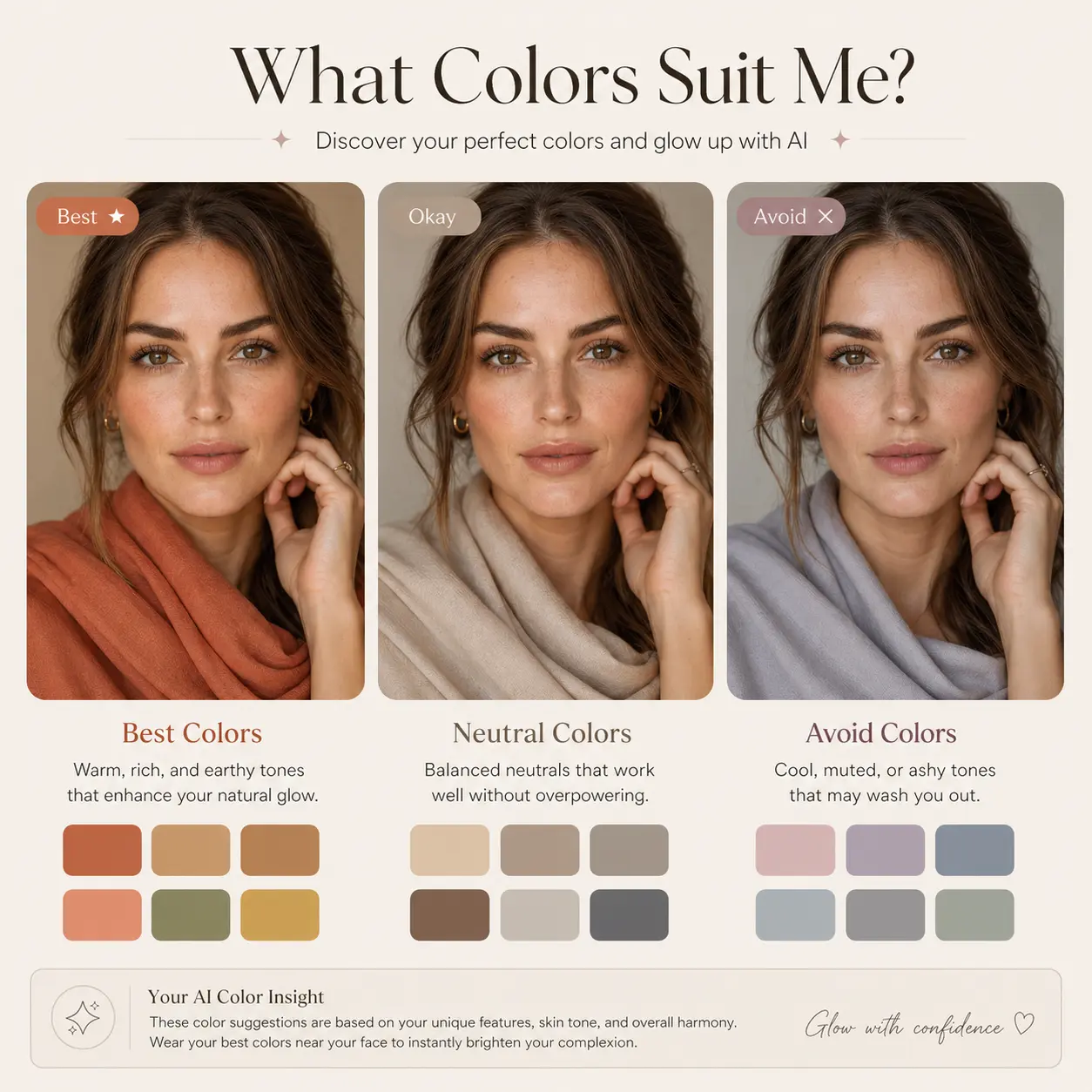
A 16-season result is useful only when it turns into practical choices: colors near the face, safe neutrals, makeup tones, hair color direction, and avoid colors.
Why 16 seasons exist
The classic four-season system is useful but broad.
For example, both Soft Summer and Cool Summer are cool, but Soft Summer is more muted while Cool Summer is cleaner and cooler. Deep Autumn and Warm Autumn are both warm, but Deep Autumn needs more depth.
16 season analysis tries to reduce this gap by giving more precise palette direction. It is most useful when a broad season explains part of your coloring but still leaves you buying colors that look "right on paper" and wrong on your face.
When 16 seasons is worth using
Use a 16-season view when the basic result feels close but not practical enough.
It is especially useful if:
- you can wear some colors from two neighboring seasons
- one palette is the right temperature but too bright
- one palette has the right depth but feels too heavy
- makeup looks good in theory but too strong in real life
- your hair color change has shifted your contrast
If the four-season or 12-season result already gives you clear outfit and makeup choices, you do not need to force more precision.
When a 16-season result is probably overfitting
More detail is not always more accurate. Be careful when:
- the result comes from one dim or heavily filtered photo
- your hair is dyed a strong color and covers most of your face
- the system gives a very specific season but no confidence or reasoning
- the recommended colors do not improve your face in daylight
- you only tested colors on your wrist or against a wall, not near your face
In those cases, use the result as a hypothesis. Retake the photo in natural light, compare a few border colors, and look for repeated evidence before changing your wardrobe.
The main dimensions
16 season color analysis usually considers:
- temperature: warm, cool, or neutral-leaning
- depth: light, medium, or deep
- chroma: bright and clear vs soft and muted
- contrast: low, medium, or high
- dominant trait: the strongest visual feature in your coloring
If you are new to this, start with Seasonal Color Analysis Quiz.
A practical 16-season map
Different systems use slightly different names, but the logic is similar.
| Family | Possible 16-season directions |
|---|---|
| Spring | Light Spring, Warm Spring, Clear Spring, Bright Spring |
| Summer | Light Summer, Cool Summer, Soft Summer, True Summer |
| Autumn | Soft Autumn, Warm Autumn, Deep Autumn, True Autumn |
| Winter | Deep Winter, Cool Winter, Clear Winter, Bright Winter |
The exact name matters less than the palette behavior: warm vs cool, light vs deep, bright vs soft.
How to test a border result
If your result sits between two seasons, do not argue with the label. Test the difference.
| If your result is between | Test these color pairs near your face |
|---|---|
| Soft Summer and Soft Autumn | dusty rose vs muted terracotta, soft gray vs camel |
| Bright Spring and Bright Winter | coral vs fuchsia, ivory vs optic white |
| Deep Autumn and Deep Winter | espresso vs black, olive vs emerald |
| Light Spring and Light Summer | peach vs cool pink, cream vs soft white |
| Cool Summer and Cool Winter | mauve vs blue-red, soft navy vs black |
The better side usually makes your skin look smoother, your lips clearer, and your eyes more defined. If both sides work, the most useful answer may be "borrow from both, but avoid the extremes."
Spring directions
Spring palettes are generally warm and clear.
Light Spring often needs gentle warmth and lighter colors. Warm Spring needs golden warmth. Bright Spring needs clarity and energy. Clear Spring often sits near the Spring/Winter border, so it can handle more contrast than softer warm palettes.
Common colors include ivory, peach, coral, warm green, clear aqua, and warm red.
Summer directions
Summer palettes are generally cool and soft.
Light Summer needs lighter cool colors. Cool Summer needs cleaner blue-based colors. Soft Summer needs muted, gentle colors. True Summer is balanced cool, soft, and refined.
Common colors include dusty blue, rose, mauve, soft navy, lavender, and cool gray.
Autumn directions
Autumn palettes are generally warm and earthy.
Soft Autumn needs muted warmth. Warm Autumn needs golden, spicy warmth. Deep Autumn needs richness and depth. True Autumn is strongly warm, earthy, and grounded.
Common colors include olive, camel, rust, terracotta, chocolate, bronze, and cream.
Winter directions
Winter palettes are generally cool and clear.
Deep Winter needs depth and contrast. Cool Winter needs blue-based clarity. Clear Winter and Bright Winter need high clarity and stronger contrast.
Common colors include black, white, navy, blue-red, berry, emerald, icy pink, and charcoal.
How to use a 16-season result
Do not stop at the label. Turn the result into practical choices:
- 3 best colors for tops
- 2 safe neutrals
- 1 power color
- 1 avoid color near the face
- lipstick and blush direction
- hair color direction
- outfit color combinations
For clothing examples, read Best Clothing Colors for Your Skin Tone. For makeup, read What Lipstick Color Suits Me.
If your result has low confidence, retake the photo in natural light before changing your shopping list. A 16-season label can look precise while still being based on weak input.
A seven-piece validation plan
Before you buy a full palette, validate the result with seven small choices:
- one white: cream, soft white, or pure white
- one dark neutral: espresso, navy, charcoal, or black
- one everyday top color
- one power color for photos or events
- one lipstick or blush family
- one avoid color tested near the face
- one hair color direction, even if you are not dyeing your hair yet
Wear or photograph these pieces in natural light. If the result only works in a chart but not in real outfits, adjust the palette before spending more.
16 seasons and undertone
Undertone is still important, but it is not the whole result. A warm undertone can be bright or muted. A cool undertone can be soft or high contrast.
If your undertone is unclear, read the Skin Undertone Test. If your hair color is changing, read What Hair Color Suits Me.
What to do if your result feels wrong
First, check the input quality. Natural light matters, and low-quality photos can push a result too warm, too cool, too deep, or too bright.
Then check whether the issue is really the season:
- If every color feels too strong, your result may be too bright or too high contrast.
- If every color feels flat, your result may be too muted.
- If makeup turns orange, the result may be too warm.
- If lipstick turns gray or severe, the result may be too cool or too deep.
- If only hair color feels wrong, your season may be fine but your contrast guidance needs adjustment.
This is why a useful report should include confidence, retake suggestions, and separate guidance for clothing, makeup, hair color, and avoid colors.
Common mistakes
- Treating a season as a personality type.
- Assuming all colors in a palette work equally well.
- Ignoring contrast and hair color.
- Choosing a palette from one bad photo.
- Using indoor lighting for color testing.
- Buying a full wardrobe before validating a few colors.
Should you use 12 seasons or 16 seasons?
Use the system that gives you useful decisions. If 12 seasons already explains your best colors, it may be enough. If you sit between two palettes, 16 seasons can give better nuance.
Start with the What Color Suits Me Quiz, then use your result as a practical shopping and styling guide. The best result is the one that helps you choose your next top, lipstick, hair color direction, and avoid color with less guessing.